Saturday, December 4, 2010

Photographer Ron Chapple Interview


Ron Chapple on assignment in the Yukon at minus 28 degrees with his new Aerial Photography business..

Industry Leading, Innovative and Super Successful Stock and Assignment Photographer Ron Chapple Interviewed:

Ron, you got an early start in photography even opening your own studio right out of college. You jumped into stock at a good time back in 1992, and embraced Royalty Free at the right time as well.  In fact, you built up a significant collection, Thinkstock, which was acquired by Jupiter images.  Now you have iofoto, which I hear is a very strong micro collection. 

John, I really appreciate the opportunity to be interviewed for your web site. Stock Photography has been a good business over the years and provided a wonderful lifestyle, however, the industry is changing rapidly and we should all be re-evaluating our business strategy. You are providing a valuable resource to the photographic community by sharing your thoughts! 

I would venture to say that part of your success in photography is due to your openness to new ideas. Would you share your views about that with us?

Change is the only thing that remains constant. (How's that for a cliché’!) Before stock, images were acquired via assignment. Waiting for the phone to ring, sending a bid, shooting the assignment, and waiting to get paid was the business process when I started my career 30 years ago.

Within a few years, art buyers began to source images on a Rights-Managed basis. At the time, a studio strategy of creating images for sale as Rights-Managed stock was revolutionary, and controversial! I had more than a few photographer friends tell me that shooting stock was wrong. Fast-forward to current day and RM is considered the backbone of the stock industry!

With that perspective, it was just a matter of time before new stock licensing models would develop. The need for images never changed, just the pricing and delivery options. Microstock is just another business model.

I believe that if you have committed to making stock photography your primary revenue source, then you need to test and evaluate every new business model. The decision is simply to determine the business that works best for you; all choices are valid options.

I also would add that "stock" should encompass more than just licensing the rights to your images. While "Assignment" is a service business, "Stock" is a manufacturing business. There's this crazy dude named John Lund that makes crazy pix of animals doing crazy human things, then he sells them as puzzles and posters. This is manufacturing and a variation of licensing your images as stock. John smartly figured out how to extract licensing revenue from the retail end user instead of the art buyer.

You have as much, if not more, experience in pretty much all aspects of stock photography as anyone. I don’t think anybody can really say what the industry is going to look like five years from now. Many are saying the ride is over, and a few are saying that new opportunities are on the horizon.  Where do you stand on that?

John, I'm the eternal optimist. At best, the industry is in a significant transition to a business model where everyone has enough revenue to make a successful career from shooting stock. Right now, there's too much power on the aggregator/distributor side. The "agencies" decide what images to upload, what fees to charge, and how and when you get paid. While this has always been the general state of business, there was much more "give & take" 10 years ago. Agency and production strategies were planned in harmony. For example, I collaborated directly with FPG International on creating the first images of multi-ethnic children, and the first images for the gay/lesbian marketplace. (FPG was integrated into the Getty Images collection in the late 1990s.)

I do believe the ride is over for photographers (like me) who produced high-end RM and volumes of high-end Royalty-Free material. The revenues from these licensing models and from microstock cannot support the infrastructure we built to manufacture these images. While outsourcing helps turn retouching, key wording and uploading into a variable cost, the overall revenues are much lower. Our high-end production model required enough profit to take a few hits in a downturn, or to fund research into new image styles and delivery processes. We always budgeted 20% of our production expenses to shoot crazy off-the-wall images just to see how the market would react.  Those days are long gone.

There are still a few shooters who may be able to make this work, but my guess is that margins are so tight that these photographers are extremely careful about the types of images they produce and the production investment. Ten years ago, investing $10,000 into a single day of production was a no-brainer. I think you would find very few shooters willing to invest the same funds today.

Can you share your microstock experience with us, and what you have learned from it?

First, I think microstock is a wonderful opportunity for the thousands of new and established photographers who want to earn income from their images. Stock can provide a lifestyle that offers creativity and flexibility. The stock business was a huge success for my business career, and I am supportive of this opportunity for any photographer.

My studio had early success with microstock through our "iofoto" collection. While this 17,000 image collection continues to provide revenue, the numbers have dropped over 50% in the last 18 months. While some of this might be a result of the economy, I believe that most of the revenue downturn is from the overabundance of images. When we started, most micro sites only had 1,000,000 images. Now those same sites have over ten million images! The statistical chance of making a sale has decreased by 90%. Three years ago, in 2007, we made the tough decision to eliminate our in-house retouching staff, to selectively produce images at lower costs, and to outsource the workflow. All of our cost reduction measures were to no avail- revenues continue to drop, and microstock is no longer profitable for our business.

With Change being our studio mantra and discovering that microstock was not sustainable in the long term, we looked for new opportunities. As a caveat, we did make the decision to redirect our revenues to a new business instead of marketing our "iofoto" images. Perhaps if we had been more diligent, we could have propped up our microstock revenues for a longer time.

What strategies would you recommend for those who want to pursue stock photography during this transition phase of the industry?

1. Do not rely on stock as your sole revenue source.

2. Aggressively explore other ways of extracting licensing revenue from your images through product sales, bulk licensing, or value-added services.

3. Keep shooting! Produce some images for stock, but create mostly images for yourself. Don't lose sight of why you wanted to shoot in the first place.

You have experience with Rights Managed, Royalty Free and Micro.  Can you share your insights and ideas about where those different pricing structures are headed, and if any of them, all of them, or none of them offer long-term possibilities?

I honestly have not spent much time thinking about how these structures will evolve. I do think the "low price image" and crowd-sourcing are here to stay. My only conjecture is that once a search engine gets involved in licensing images, many of the current distributor channels will be challenged to offer a compelling reason for customers to visit their web site.

You are once again off into a new area of photography with your aerial business. Can you tell us about your new venture, how it came about and how it is working out?

Ron prepares for a flight in Hawaii.

The Cineflex gyro-stabilized system, with the helicopter mounts, power supplies, monitors and record decks, is a $600,000 investment...a definite "barrier to entry"!

Route map of a flight over San Francisco.

Many people may not know this, but I have been shooting aerials as a sideline to our lifestyle stock for 25 years. When I first realized that the microstock revenue growth rate was not sustainable, I started to look at other opportunities. 

Stock was experiencing a 10 year downward trend of lowered prices and decreased percentage splits to the photographer with microstock being the newest iteration. Increased volume could only compensate for some of the loss in revenue percentage. My strategy was to look for revenues with a contrarian approach. I researched the market to find a niche that would have minimal competition, offer significant barriers to entry, and be somewhat recession proof. I asked the question "What is the most expensive type of project that a client could possibly commission?" The answers weren't hard to find... aerials or underwater work seemed to occupy the high end cost of the content continuum. With encouragement from a stock house, and a friend in the helicopter business, I chose to invest in a state of the industry Cineflex HD aerial video system. 

The Cineflex gyro-stabilized system, with the helicopter mounts, power supplies, monitors and record decks, is a $600,000 investment. If I was looking for a "barrier to entry" I had found one as financing required committing collateral, a second mortgage and personal guarantees. 

Business has been excellent. While we are still in a growth/investment phase, revenues have been doubling every year for the past 3 years. We hope to break-even in 2010 with tons of new opportunity on the horizon. We ended up investing over $2,000,000 with the purchase of 2 more systems, and new platforms to carry the Cineflex. Any new business will take 4-5 years to achieve success, so toughing out those early years is hard work, always painful, but absolutely necessary.

Most of the growth has been in the international market. In 2009, 60% of our revenues came from USA clients that needed to shoot outside of the USA, or from clients outside of the USA that required shoots in the USA or other countries. Export of the Cineflex V14HD is governed by the International Trade and Arms Regulations of the US State Department, plus we need ATA Carnets for customs, and Visas to work in certain countries. We rapidly developed an expertise in wrangling complex international projects. In the last 2 years, we have completed projects in Taiwan, Kuwait, Brazil, Costa Rica, Chile, Oman, Samoa, Nicaragua, and Canada. We commonly have weeks when all of our equipment and crews are outside of the USA.

And never say never… as a still photographer, I really did not think we would be involved much in video or technical fields. Now, our studio also provides HD video editing services and we utilize Google Earth for pre-flight planning, post-flight analysis, and accurate captioning. Our team has quickly learned entirely new skills that extend the value of our aerial filming services. 

For any photographer wondering about the future, I would add that "life after stock" is a rewarding experience. The lessons learned in the stock industry lends itself well to new endeavors.

Using photography to create a rich life is of particular interest to me. From where I stand you have always done a great job of that.  Is that just the way it has worked out, or is that part of your plan?

The lifestyle was the first choice. I always wanted to travel as a young photographer, but could not afford the expense. I decided that shooting "location work" might be the travel ticket I needed over 30 years ago. I invested in a shoot at the beach with two models to revamp my portfolio to target location work. Of course now, the travel can be way too much! In the past 10 months, I have only been home for a total of 5 weeks.

But remember, when you run your own business, you can't get fired. And those things called vacation are just a dream you will pursue for many years... This change has not been without personal emotion. I went a year without shooting a single image... but I had made the commitment to Aerial Filmworks, and aerial video was our new priority.

Sleep is truly a waste of time. The opportunity to experience a new location or new emotion trumps sleep any day of the week.

Do you have a current favorite image or video clip of yours that you can share, and tell us the story behind?

I'm less motivated by a favorite image than the process that happens along the way. For me, the excitement of discovery is when the frame comes together in front of you, and you have no choice but to shoot.  As a photographer, I'm not trying to make a statement, I'm just interpreting the elements and emotions that are being revealed, and the more variables the better!

Listening to the miles of stories from people in every walk of life are the true everyday pleasures of a photography lifestyle.

It appears that for you photography is very much a team process. Can you share your approach to putting together a team?  Is your team still in place?

The team approach allows new ideas to emerge and keeps the creative process fun! A business owner must always hire people way smarter than themselves. I have always been fortunate to be in the company of really talented people at Ron Chapple Studios. When we hire new team members, I'm the last person to talk with them, and then I'm only there to answer questions. A new employee must be selected and interviewed by all existing staff first. Only after they approve a potential new hire, will I meet with the person.

Are you still producing any stock images? Stock footage?

Yes, we are producing a few images whenever we find ourselves involved with a unique image opportunity. We will likely not submit any significant volume to our microstock distribution channels. Our "iofoto" collection already contains a good cross-section of lifestyle, product and scenic images. Recently, we have been exploring bulk licensing deals for 1,000+ images at a time that have worked out quite well. The net revenue per image is low, but the overall ease of the transaction and net income are worth the effort.

We are actively producing aerial stock footage for distribution through Corbis Motion. While revenues are on an overall upward trend, we are nowhere close to a break-even level. Stock footage is way harder to sell than stock images. There's many different acquisition formats, and directors are usually looking for specific camera moves and lighting in addition to the variety of technical options. Also, many of the networks require exclusive rights which necessitate original production. 

I think that as the Internet matures, image search becomes more effective, and photographers increasingly put their work online, direct sales may be one of those up and coming opportunities. Can you share your thoughts on direct sales?

Direct sales are the future. I can easily see the photographer percentage increasing to 80% or more as the "search engines" will simply charge a transaction fee. This will likely only affect royalty-free and microstock sales as licensing is simpler.

I'm not sure about direct RM sales. This seems to be a relationship business that may remain the domain of a few select agencies as well as photographers with unique collections.

How important is the Internet to your business?  

Absolutely critical. We get 90% of our new business through internet searches. We work in multiple time zones so email and online travel arrangements are essential. We use Google Calendar for all of our scheduling, and archive everyday documents on Google Docs.

We are late to the Facebook, YouTube and Skype applications, but slowly learning how to integrate these opportunities into the business. I have yet to become a Twitterer...

Do you put any effort into SEO?

Yes! Search Engine Optimization is the most valuable part of our online efforts. We avoid glitzy Flash sites, go text heavy and update our pages frequently. We have been able to maintain the #1 organic search result for our market. Over the past few years, we have also acquired several hundred generic domains to capture natural "type-in" traffic. 

We have tried print advertising in regional and national directories with lackluster results.

Do you have any last words of advice you’d like to leave us with?

John, that is way too much responsibility! 

There's a couple of things I try to keep reminding myself every day:

First, I try to never forget why I wanted to be a photographer- and while this may be either too simplistic or too esoteric, the opportunity to explore new landscapes... visual, geographic or emotional, continues to be a driving force. The camera is like a passport, not always to other countries, but to other emotions, and to new relationships. The camera can also deliver ugly Rorschach ink blot results, but I will sweep those under the carpet for now!

Second, stock photography is a business. The most creative photographer will always lose out to the better business person. This was a stunning revelation many years ago, and really frustrating. We must learn and relearn how to be better business people. Maybe that means we shoot some images for our soul, and others for money. Early on, I had a "business adviser" tell me that I needed to transfer some of my ego fulfillment from taking a good picture to running a good business. Those words also helped me understand that we as photographers should not be afraid of the business world. Business is just a game we need to play so that we can enjoy our lifestyle.

Thanks again John!
There really is an end of the rainbow in Ron's sights!

Just another day at work for Ron Chapple!

Filming Hawaiian Airline's first airplane off the coast of Oahu..

Ron's Aerial Photography Business: http://www.aerialfilmwork.com
Ron's Web Site: http://www.ronchapple.com/


Saturday, November 20, 2010

Empty Rooms and Opportunities In Stock Photography

Doctors and surgeons holding power tools and wrenches as they stand in an operating room in a hospital in a medical stock photo.
A painfully humorous stock photo of surgeons with power tools in an OR came about from my having photographed and empty operating room.
Opportunity And An Empty Operating Room
It was my own little experience with the operating room that inspired me to make a series of images on the medical industry (a visit to the emergency room ended up in abdominal surgery and a five day stay in the hospital.  I had to have a follow-up operation and I sought permission to video and photograph the procedure…(well , permission for my friend Shalom Ormsby to record it), for stock photography. Amazingly enough, permission was granted. That shoot led to a medical shoot of my own after my recovery. As part of that second shoot I photographed an empty operating room figuring that eventually I would have a use for it. Over the years I have wasted tremendous opportunities by not thinking with a wide enough net. I should have photographed every room, office and space that I have used in shoots as separate shots, from multiple angles and altitudes, as both legitimate stock shots in their own right and as resources for my composite imagery.

Doctors in the Operating Room

Several months after shooting in the operating room I was putting together a shot list for a shoot centered around some business ideas. After coming up with a primary image I was looking through my archive of resource pictures trying to come up with additional image concepts when I saw the photo of the empty operating room. Of course, the first idea that came to mind was a “traditional” portrait of a doctor or surgeon in the OR.  That has been done to death of course, but even another one would probably sell. BTW, it did sell the first month it was up online…twice actually…but I digress. I really wanted to come up with something different, some that hadn’t been done before, or at least done to death.

Power Tools In The Operating Room

I remembered seeing a “House” episode on TV in during which the esteemed television doctor performs an amputation on a patient trapped under the rubble of a collapsed building. It looked as if he used a “sawsall “or reciprocating saw. That was my answer. I chose to use three different people, posing as surgeons, each a holding a different tool. We ended up using a reciprocating saw, an electric drill and a pipe wrench. I simply photographed each of the models in surgical gowns or scrubs or what ever that clothing is called, in my studio, then stripped them into the operating theater photo. The final image could work for concepts from auto repair to medical insurance to, well,  a whole bunch of things!

Medical Images and an Empty Recovery Room

I ended up with the medical photos and, with the business images included, I was able to get about fifteen different shots from the models in a few hours of work. That may not seem like a lot to shooters who manage to pump out photos in a way Henry Ford would have been proud of, but for me that represents a pretty good investment. The key to this series of medical images (I ended up with one portrait of each model in the hospital OR and the image of all three of them together holding the tools), was to have the presence of mind to shoot the room from various angles while it was empty…something it has taken me years to learn to do! As I mentioned above, the first month these images were up I had three sales (two of the “traditional portraits and one of the doctors holding tools), so I think they will do well. Now, I still have some shots of the empty recovery room….

Wednesday, November 17, 2010

The Case Against A Stock Photo Niche


Business on the go, speed, and connections are the concepts illustrated by this stock photo.
Business-on-the-go is a popular stock photo concept and comes with an over supply of imagery. Financial success will come to the photographer who can best create images that satisfy that concept and compete successfully with the other images.

Creating Images That Compete
One piece of common advice for photographers is to specialize, to find a niche’ and focus on it. Particularly in these days of image over supply you hear how important it is to shoot images that aren’t competing with the plethora of popular subjects…a favorite example being that of a person on a cell phone. I personally feel that such advice should be taken with a grain or two of salt. I believe it is important to create images that, rather than not competing, are competing successfully. If you want to have a successful (read “earn lots of money”) career in stock photography you need to shoot the popular subjects…and you need to diversify…both of which fly in the face of advice pointing one towards a “specialty”.

The Case For Specialization In Photography
Ever since I started my pro career back in the mid-seventies I have heard that I needed to specialize. I certainly believe that specialization does make it easier to get assignment work…and indeed, back when I shot assignments I did specialize. I specialized in location work; I specialized in agricultural photography, I specialized in special effects photography, I specialized in Photoshop work and on occasion I specialized in a lot of things I don’t even remember! But I do remember that I always resented the fact that I had to specialize…and one of the great “aha!” moments I had was when I realized that in shooting stock I didn’t have to narrow myself to any one subject or style.  Indeed, that was one of the main reasons I gave up assignment work for stock.

A Photo Niche and Less Revenue
While developing a niche for your stock photography may be right for you if you market your own work and can get an appropriately high licensing fee then more power to you. It will be rare to find an agency that will demand a higher price for such imagery so if you distribute through the typical agency you will simply end up with fewer sales and less revenue.

The Secret to Success
I believe the secret to success is to create images that do cater to the popular categories and subject matter…but to create images that clients will want more than the other guy’s picture. Not an easy task…but I am not promising a rose garden here. To achieve success in stock you are going to have to create truly compelling images of popular categories and subject matter and distribute them effectively. That means choosing the right model for the image (RM, RF or Micro), being prolific for the type of imagery you are doing (for me being prolific is a few hundred images a year) and choosing agencies that people actually go to and license from.

Testing The Waters
I also believe in diversifying. Having a primary style, for example, is fine, and in some cases is so strong it is hard to argue with (think Colin Anderson). But for most of us mere mortals it is important to try new things to both test the waters for finding out if there is a strong demand for new styles, and to insure that if demand changes for the style (or subject) that is our bread and butter, we won’t be left high and dry. Besides, trying new styles (or subjects) out can help keep us fresh and creative.

Business On The Go
In my recent trip to Thailand to shoot source material for my stock images I played a lot with zooming during my exposures as well as shooting long exposures of lights at night. The past two days I have given myself “permission” to play with those images the result being a series that are unlike other images I see on stock sites. While the style is an experiment, the concepts of speed, transportation, shipping and business on the go are popular ones and always in demand. Will these images sell? My gut tells me they will…but it also tells me they won’t sell a lot…so I will place these images in the Rights Managed category.  By the way, my gut is not always right…but I will find out if this is a viable style by having these images out there in circulation.

Images I Want To Create
I want to create images that compete effectively for popular categories and subjects, I want to stay fresh and creative, and I want to continually test the waters for what images the market place wants. For me, and my career in stock photography, shooting for a niche is not the way to go.


Saturday, November 13, 2010

Forget about Search Engine Optimization (SEO)


A businessman organizes online content in a futuristic office environment.
SEO (Search Engine Optimization) is secondary to content for building significant traffic for your photography (or other) business.

SEO, Quality Content, and Search Terms
Am I serious when I suggest to photographers that they forget about (SEO) search engine optimization? Well, yes and no. The point I want to make is that SEO is really about fine tuning your website. It can be important, but it really isn't the most important thing. If you want traffic to your site, and the ensuing benefits (for me that means selling imprinted holiday gifts through cafépress.com, licensing stock images, selling fine art prints and earning revenue through click through ads), then what you really need is content, quality content. Almost invariably the photographers who have substantial amounts of traffic get that traffic through a large number of search terms, not by being number one in any given search.

First Page Ranking And Increased Traffic (or not)

It may seem like being ranked on the first page for a desirable search term is the answer, but there are a couple of reasons that such a goal might not be the best approach. For one thing, getting ranked on the first page for anything other than your own name can be rather a daunting task (and even there I am up against a famous actor named John Lund as well as several other photographers who for some odd reason have my name). If you are just getting started you have a huge disadvantage going up against those who have already secured their positions. You will have to get past those who probably know what they are doing and have a huge leg up in terms of what search engines value: content, links and time. Secondly, ranking highly for a given term doesn't always bring the traffic you think it might. That was driven home to me when, over a two week period of time, I constantly ranked, with Google, between four and six for the term "stock photos". During that period of time I found no detectable increase in my traffic from when I was ranked in the low hundreds, which is where I have fallen back to today for that particular search term.

Traffic Comes From Content

Today, for example, I had over five hundred people get to my site from search engine queries (other traffic comes from those "links" and referring sites). The number one search term that brought visitors to my site was the term "John Lund" with 5 visitors. No surprise there, the surprise is that I only had eight search terms that brought in more than 1 person. 99% of my traffic comes from search terms that are only searched for once in any give period of time. To get truly significant amounts of traffic you need a lot of search terms and you get a lot of search terms by having a lot of content.

Content, Links and SEO
The two things that search engines value most are content and links. You get links by having content that people value enough to link to. So it all comes back to content. In a sense, photographers are fortunate to have content to put up…and yet pictures hardly count. Search engines can’t “see” pictures…so pictures become a kind of excuse for the words, which hopefully entice humans to come see the photos. SEO, or search engine optimization is simply the process of organizing that content to make it most accessible to search engines, and to people. Remember, the "robots" that search engines use to index the Internet (and hopefully your site) are themselves optimized to "think" like humans…because the search engines want to deliver good results to humans. Search engine optimization is something the search engines want you to do well, and Google, with the lion's share of Internet searches, is happy to tell you what to do for SEO. But the most important thing you can do to generate traffic for you web site is to provide quality content. That is why I say to forget about SEO (OK...not entirely), because without the content the SEO isn't going to do you much good.

Quality Content, Links and Time

Quality content will bring links and links will raise you in the rankings increasing both your traffic and, bringing in more links. It all takes time though. Lots of time. I estimate that three to five years are needed to produce the kind of traffic…thousands of visitors a day…that will lead to a significant difference in your photography (or other) business. It can be done. Photographers like Quang-Tuan Luong, Rolf Hicker, and Dan Heller have proven that. Content, links and time comprise the path to traffic. SEO is great, but your priority should be quality content, and lots of it.

Achieving Internet Success In Your Photography Business
Because building significant traffic does take a long time, and loading content is a grueling process (I am thinking here of the process of uploading, keywording and captioning photos),
I think it is best looked at as part of an everyday routine. I try and do a little bit each day. It is that old slow and steady wins the race kind of thing...where one day, maybe three years from now, you stop and think to yourself "Man, I am so glad I did this!". I guess I'll let you know about that in another year or two!

Wednesday, November 10, 2010

Interview with Photographer Quang-Tuan Luong


Photographer Quang-Tuan-Luong Interview:

Quang-Tuan Luong, Phd., is much more than a world-class photographer. From a technical climber to a mountain guide to a University professor and contributor to the fundamentals of artificial intelligence, Quang-Tuan has found his own way to professional photography. His site, Terragalleria, is the most frequented of any individual photographer's site on the internet and he now earns his living entirely through business brought in through the Internet. A complete bio of Quang-Tuan Luong is available at Terragalleria .


To say you have achieved some impressive traffic figures for your web presence is an understatement. I suspect your heavy traffic is a result of extensive text-rich content coupled with time. What do you think is a realistic amount of time to allow in building up enough traffic to turn a photography web site into a money-making endeavor?

It will easily take several years. There is this rule in the US that you have to show profit 3 our of 5 years in order for the IRS not to classify your business as a hobby, so I when I officially started my photography business (and the website) in 2001, I was anticipating that by 2003, my revenues would surpass photography expenses, which is what happened.  In 2004, traffic (as measured by Webalizer, which overestimates maybe by 2/3 compared to Google Analytics), passed 10,000 daily, and revenues reached the six-figure milestone. So for me it took three years to turn the site into a viable business. 

However, I was not starting from scratch, as I've had a presence on the internet since 1994, under the form of a fairly popular personal site dedicated to climbing and mountaineering - the contents were absorbed into the terragalleria.com site in 2002. Keep also in mind that it was easier, maybe much easier, to build traffic a decade ago. Back then, there were just a few photographers, the most notable of them being Dan Heller, who understood that you could effectively use a website as an effective pull marketing vehicle. Not many understood even SEO basics. You needed technical knowledge to build a site. There were no blogs or ready-made image galleries.  Nowadays even fairly advanced SEO features (some of which I have yet to implement on my own website!) are built-in as a standard issue in a service such as Photoshelter, which, last I checked had more than 50,000 accounts. That's a lot of competition, so I expect it will take longer than three years if you are starting now.

I have noticed that sites such as yours that draw significant numbers of visitors seem to do so from a large number of search terms…I guess you would say a lot of long-tail keyword hits. Is that the key to building traffic?

This sounds accurate. Looking at my Google Analytics statistics for the month of Oct 2010, I see that 300,000 search engines referred visits entered using 130,000 keywords, with the top 1000 most used keywords accounting only for 86,912 of visits. Here is a more detailed breakdown:

1-10: 13,891
1-100: 36,363
1-1000: 86,912
1-5000: 135,700
1-133,000 : 300,000
What other strategies can photographers employ to build their success on the Internet?

You mean other than SEO ? Social media has worked very well for some. For examples: Trey Ratcliff generated a tremendous following with his blog, or Patrick Smith with his Flickr posts, "Thomas Hawk" with both, etc....

How do you divide your time (i.e. between shooting, making prints, administration & Internet work)?

Shooting time has been in the 10-20% range. I don't have a clear breakdown for the office work, but I am spending a considerable amount of time to create high-quality digital files.

Do you get more revenue from fine art prints or stock licensing?

Half a decade ago, revenue from licensing was larger. At one point, a few years ago they became even. This year, I am seeing a sharp decline in licensing, which is now well surpassed by prints. Like everybody, my licensing fees have eroded, but on the other hand, I've steadily raised prices for my prints and so far they continue to sell well, maybe because my reputation as a artist is growing.
 
I see you have Google ads on your site. Is that a significant source of revenue?

I started to use Adsense in 2008 at the urging of friends. I am still unsure whether it is worth it and I am always thinking of leaving the program altogether, but in this climate it's not that easy a decision to drop a source of revenue that adds to diversification and doesn't require any effort on your part. 

Can you share with us the percentage of your income from prints vs. Stock licensing and web advertising on your site?

2005
licenses 48%
prints 35%
personal subscriptions 15%
ads 0%

2010 YTD:
licenses 28%
prints 52%
personal subscriptions 5%
ads 12%


Do you have other sources of photography income?

I'd be tempted to say none, but that would be slightly inaccurate. I have a few hundred images with a small French stock agency.  The agency owner is a real "agent" (unlike the big stock houses) who was willing to help me when I got started, which is the main reason I haven't pulled out the images although they don't generate any significant income.  I think that's pretty much it. So far I have not taught workshops, done consulting or writing,  or sought assignments and/or commercial jobs. This has allowed me to concentrate on making the photographs I wanted to make.

One of the most vexing problems for me is how much to charge for my work. How do you go about pricing yours?

I am certainly not the best businessman around, and I am sure I've lost many licensing opportunities, as I use a simple method and have an inflexible minimum fee, which is fairly high. I check the Getty, Alamy, sometimes Corbis rates as well as the rates I've obtained in the past. Then I try to evaluate the request individually to understand the value they are actually getting from the use, and give them a discount accordingly.

Does it take much work to keep your traffic high, or does traffic beget traffic?

It's true that the more traffic you have, the more people link to you, and probably the more search engines weight you. This creates a positive feedback loop, which makes it very difficult to displace the most trafficked sites. Yet, I am not taking chances. I constantly add new images (at least 2,000 per year),  pages to the site, and often new features as well.

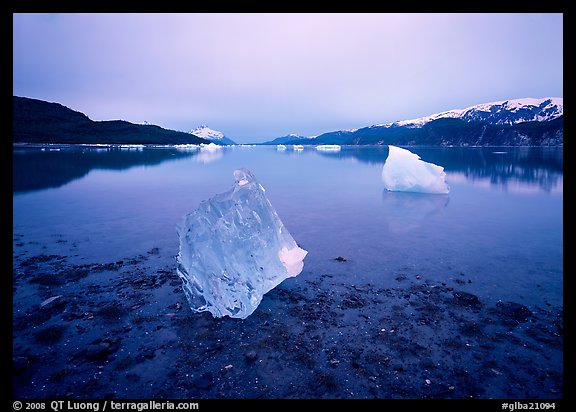
Can you share one of your favorite photos and the story behind it?


On the first day of our ten-day sea kayak trip, we had gotten up at 6am.
After a full day of paddling, we arrived at our
destination, a grassy flat near the mouth of McBride Inlet, at 2am.
By the time we had finished setting up camp, it was 3am. I retreated
to my tent, but didn't feel asleep. I felt excited by possibilities
and energized by the clear sky and the lingering half-light of the
Alaskan summer, that I could sense getting brighter. The world felt so
beautiful and just invited exploration. I wandered around the tidal
flats until I saw this translucent iceberg that was lying more than
a hundred feet away in water. I knew that the water was very shallow,
and that with the fast rate at which the tide was moving back, if I
waited, it would be totally out of the water. So I immediately wadded
into the water with the camera mounted on a tripod, the lupe and dark
cloth around the neck, and a film holder in my pocket. This image
reminds me of the curious state of heightened awareness I found myself
in after being awake for almost 24 hours.


What photography project is currently at the top of your list?

It's been winding down, but I am still working most actively on the National Parks project. 

What advice would you give aspiring photographers?

Shoot what you love, not what you think may sell. I think it is shortsighted to shoot only what you think will sell. First, because you don't know with any degree of certainty what sells and what doesn't. Second, and more important, because, as an artist, what you should be trying to create is raising your profile.  This is done by producing outstanding work, which is awfully difficult if you don't love what you are shooting. By the way, I am taking my own advice. Personally, I never expect all the images I publish on the website to sell. They are there because I find them interesting for some kind of reason.

What advice would you give photographers who want to have more effective web sites?

Have a clear goal and a path to realize it. I see a lot of photographers trying to achieve all sorts of things with their websites: stock licensing, print sales, getting assignments, you name it. Yet when you analyze the components of their sites, you see that none is particularly effective for any of those goals. For instance, since you are a stock shooter, you know that stock is a numbers game. Yet many do not even design in order to maximize traffic.

Facebook is capturing an increasingly greater percentage of web traffic. Are you utilizing Facebook (or any other social media), and/or do you have any opinions on the importance of incorporating a Facebook presence into a photographer's strategy for visibility?

I've been testing the waters but I remain skeptical of the value.  On FB I have only a personal page because I do not like the idea of an artist setting up his own fan page -  although from a SEO point of view it does make so sense. For status updates, I prefer twitter, there seems to be more information and ideas flowing around.

Do you utilize flickr or other photo sharing sites (and if so how)?

No. I would if I had the time.

Do you promote yourself outside of the Internet?

Just a few years ago, I suddenly realized that as a visual artist, you have to exhibit your prints, because, even in this day and age, the print remains an ultimate realization of your work. So although I have a short exhibit history, I've been trying to catch up. Other than that, I've never sent any promo piece or solicitation to anybody so far. Unlike some, I don't really like to promote myself or even to sell. With that respect, my Internet strategy was a good match.

What qualities in you are most responsible for your success as a photographer?

Same as the qualities that were responsible for my success as a scientist: curiosity, persistence, ability to grasp the "big picture" and at the same time take care of details and technicalities.

Where do you want to shoot that you have not yet been to?   

Everywhere (truly, even in the US Midwest!,) but especially in the Himalayas, South America, Africa, and Antarctica.

What is your biggest challenge as a photographer?

To create work which is fresh and meaningful. There is so much great work that has been created in the past and right now, it's difficult to find new ideas. When one tries to shoot with a new style or new techniques just to be different, it often ends up being gimmicky.

What is your biggest challenge as a photography business owner?­

To understand emerging trends in business and technology and take advantage of short windows of opportunity. If I hadn't understood the importance of search engines on the Internet a decade ago, I wouldn't be there today. However, nowadays, everybody is doing SEO. So what's next?

Are you optimistic or pessimistic about your future in photography?

I am optimistic about my future in photography. I feel I still have so much to learn, so much room to grow that the journey is going to be very rewarding. It could be that ten years from now, I will be at a very different place, and doing very different work than what I've been publishing so far.

What I am not necessarily optimistic about is the business of photography. Although the year is not finished yet, at this point it is a given that for the first time in 10 years I will experience a decline in revenue. There are some worrisome economic trends that you know well.  Historically photography has not always supported that many full-time practitioners, and we might return to that situation in the future. But that's OK.  Some of the most enduring and celebrated work in photography didn't sell well at the time it was created.

Monday, November 8, 2010

Having Fun and Making Money In Stock Photography

Funny picture of a tourist mounting an elephant during
"Mounting" an elephant during "Mahout" training can be...well...scary (but fun)!

Crop in on my face and you can see how much fun I really am having!

Elephants, Crocodiles and Creativity and Fun
I have just returned from a quick trip to Thailand where I photographed elephants, crocodiles, tigers and the flotsam and jetsam of travel. Getting out of my normal existence both provides me with fresh material to create my images and reminds me that there is so much more than sitting behind the computer creating stock photos. On this trip I got to hang out with elephants (during a "Mahout training experience"), play (that's right...I said play) with tigers, get a glimpse of everyday life in Thailand while visiting a Thai friend, got to taste coagulated pork blood (in an otherwise pretty good soup) and just plain had fun. Travel gets me recharged and stimulates new ideas and creativity, and a big part of that is having fun!

There Is Still Money To Be Made In Stock Photography
One of the first things I did when I got into my studio this morning was to check out my sales report at Blend Images. It was encouraging to see one image that I recently created, in its first quarter, made fourteen sales and brought in $343.73 cents to me. Sure, there was one sale for $1.40...a sign of the times, but there was one sale for $126.00 and several in the $50.00 range. It seems strange to be enthusiastic for such small sums (coming from an RM background) but they do add up. Keep in mind also, that this was the first quarter that this image was available and, if it follows the norm, sales will build over time. I have noticed that a satisfyingly high number of my recent images have been doing well. There are other images that sold more times, and a whole lot of images that sold fewer times, and made me less money, but this one caught my eye because I really didn't expect it to do quite this well. After twenty plus years in stock I still can't tell how well an image will do with any certainty, but at least I can say that despite all of the negative news out there, there is still money to be made in stock photography.

RM vs. RF: A Balancing Act
One thing that isn't fun for me is determining whether an image should be RM or RF. The image in question is an RF image. I create and contribute RF images because I actually do make money on them. I am convinced that for some images they will make much more as RF than RM.  On the other hand many designers and art directors I speak with claim they can't afford RM images. Of course, I think they are mistaken...but what they believe becomes their reality and I believe it would be a mistake to abandon such a huge section of the market for stock photos. I prefer to make images for the RM market, and I still make about half of my images for that RM market, but RF has become integral to my income. My Rights Managed income has  become much more volatile while the Royalty Free income is much more stable. I am always performing a balancing-act trying to decide which images to put where, which will do best in RM and which in RF. It makes me a little bit crazy, but then you have to be a bit daft to be in the business anyway!

Old Concepts, New Work and Inspiration
I have to admit that upon returning to my studio I also took a quick look at some of the new work on various agencies. It is a little frightening to see the never-ending torrent of un-original work that continues to pour into the marketplace. What a treat it is to come across the occasional image that has some emotional appeal, some clever new way of expressing a tried-and-true concept, and especially to come across an image that is so special it blows me away and encourages me to press all that much harder to come up with my own images that are truly worthwhile.  I have to admit that finding images that really inspire me doesn't usually come from searching stock agencies. Such special images are certainly in the agency collections, but can get buried pretty deeply in with all the lesser images.  In any case, it sure seems clear to me when I look through photography, whether it is in agency collections, magazines or just Googling the net, my future in stock is in making unique and interesting imagery. Actually, I believe that anyone who hopes to do well in stock photography needs to be making at least some images that inspire. For me, one of the best ways to creativity, and therefore inspirational images, is through having fun!


Tuesday, October 26, 2010

Elephants, Tigers and Shooting Stock In Thailand

My impromptu head massage by an elephant during a stock shoot was actually kind of creepy...and slimy!

Elephants, Tigers, Alligators and Shooting Stock
I am off to Thailand early tomorrow morning for twelve days of shooting stock. My partner Stephanie and I will be keeping our eyes open and cameras ready to capture whatever opportunities come up as well as undertaking a few planned shoots. We have arranged to photograph elephants, tigers and alligators (or are the crocs?). All in all it should be a fun and fruitful trip!

Elephant Massage
As you can see from the elephant photo above (that’s me getting the head massage), I have shot elephants before in Thailand. BTW, having an elephant’s trunk massage your baldhead is actually kind of creepy…and slimy! I had a great time shooting elephants before and have arranged to spend a day learning to be an elephant Mahout (trainer). I get to spend a whole day with my own elephant learning how to direct him or her, giving the elephant a bath, and then taking a jungle trek atop the great beast! All the while Stephanie and I will be keeping ready for photo opportunities for our stock collection and raw material archives.

Expectations and Attitude
I did photograph a tiger here in the U.S. once, but this should still be fun and a great opportunity for some awesome “parts” from which to create my composite, conceptual stock photos. Of course, part of what makes for a successful stock photo trip, for me, is not getting too attached to your “expectations”. There are quite a few things that can go wrong...and if they do go wrong, and you don’t get what you thought you would, why wreck your trip over it? If you don’t get the shots, you don’t get the shots…but you don’t have to suffer over it. Very Buddhist of me…and heck, sometimes I actually manage to achieve such a great attitude. I’d rather just get the shots though….

Great Selling Stock Photos and Grab Shots
I have had some great selling stock photos over the years that were grab shots on my travels, so I always try and stay as open as possible to those opportunities. Once, on a trip to Burma, I pressed my camera up to the glass in a waiting area in the Mandalay Airport (or was it the Rangoon Airport…uh…I don’t remember) and, with a touch of Photoshop, ended up with a great picture of a gangway on the deserted tarmac.
This gangway on a deserted tarmac in Burma represents both opportunities and missed opportunities as well as connections and networking.
This shot paid for the entire trip and then some with its royalties, those sales have dried up recently as there are now a spate of such images. Hey, I think that may be the first time I have ever used the word “spate” before! In another case I was in a train station in Mumbai, raised my camera high above my head, and fired off a few shots at a fifteen of a second (to blur the crowd) before a machine-gun toting guard suggested I desist…which I promptly did. However, one of those grab shots has, at this point, paid for half of that trip! Cool!
People in motion at a train station in Mumbai, India.


Internet Access, Time and Sharing on a Photo Blog
At any rate, I will try to use this photo blog to share some of my trip…but how much depends on Internet access (which should be good), and how much time I have (who knows) and, well, again, who knows! Worst-case scenario, there will be a lot more material to share when I return. Stay tuned!

Like