Wednesday, November 17, 2010

The Case Against A Stock Photo Niche


Business on the go, speed, and connections are the concepts illustrated by this stock photo.
Business-on-the-go is a popular stock photo concept and comes with an over supply of imagery. Financial success will come to the photographer who can best create images that satisfy that concept and compete successfully with the other images.

Creating Images That Compete
One piece of common advice for photographers is to specialize, to find a niche’ and focus on it. Particularly in these days of image over supply you hear how important it is to shoot images that aren’t competing with the plethora of popular subjects…a favorite example being that of a person on a cell phone. I personally feel that such advice should be taken with a grain or two of salt. I believe it is important to create images that, rather than not competing, are competing successfully. If you want to have a successful (read “earn lots of money”) career in stock photography you need to shoot the popular subjects…and you need to diversify…both of which fly in the face of advice pointing one towards a “specialty”.

The Case For Specialization In Photography
Ever since I started my pro career back in the mid-seventies I have heard that I needed to specialize. I certainly believe that specialization does make it easier to get assignment work…and indeed, back when I shot assignments I did specialize. I specialized in location work; I specialized in agricultural photography, I specialized in special effects photography, I specialized in Photoshop work and on occasion I specialized in a lot of things I don’t even remember! But I do remember that I always resented the fact that I had to specialize…and one of the great “aha!” moments I had was when I realized that in shooting stock I didn’t have to narrow myself to any one subject or style.  Indeed, that was one of the main reasons I gave up assignment work for stock.

A Photo Niche and Less Revenue
While developing a niche for your stock photography may be right for you if you market your own work and can get an appropriately high licensing fee then more power to you. It will be rare to find an agency that will demand a higher price for such imagery so if you distribute through the typical agency you will simply end up with fewer sales and less revenue.

The Secret to Success
I believe the secret to success is to create images that do cater to the popular categories and subject matter…but to create images that clients will want more than the other guy’s picture. Not an easy task…but I am not promising a rose garden here. To achieve success in stock you are going to have to create truly compelling images of popular categories and subject matter and distribute them effectively. That means choosing the right model for the image (RM, RF or Micro), being prolific for the type of imagery you are doing (for me being prolific is a few hundred images a year) and choosing agencies that people actually go to and license from.

Testing The Waters
I also believe in diversifying. Having a primary style, for example, is fine, and in some cases is so strong it is hard to argue with (think Colin Anderson). But for most of us mere mortals it is important to try new things to both test the waters for finding out if there is a strong demand for new styles, and to insure that if demand changes for the style (or subject) that is our bread and butter, we won’t be left high and dry. Besides, trying new styles (or subjects) out can help keep us fresh and creative.

Business On The Go
In my recent trip to Thailand to shoot source material for my stock images I played a lot with zooming during my exposures as well as shooting long exposures of lights at night. The past two days I have given myself “permission” to play with those images the result being a series that are unlike other images I see on stock sites. While the style is an experiment, the concepts of speed, transportation, shipping and business on the go are popular ones and always in demand. Will these images sell? My gut tells me they will…but it also tells me they won’t sell a lot…so I will place these images in the Rights Managed category.  By the way, my gut is not always right…but I will find out if this is a viable style by having these images out there in circulation.

Images I Want To Create
I want to create images that compete effectively for popular categories and subjects, I want to stay fresh and creative, and I want to continually test the waters for what images the market place wants. For me, and my career in stock photography, shooting for a niche is not the way to go.


Saturday, November 13, 2010

Forget about Search Engine Optimization (SEO)


A businessman organizes online content in a futuristic office environment.
SEO (Search Engine Optimization) is secondary to content for building significant traffic for your photography (or other) business.

SEO, Quality Content, and Search Terms
Am I serious when I suggest to photographers that they forget about (SEO) search engine optimization? Well, yes and no. The point I want to make is that SEO is really about fine tuning your website. It can be important, but it really isn't the most important thing. If you want traffic to your site, and the ensuing benefits (for me that means selling imprinted holiday gifts through cafépress.com, licensing stock images, selling fine art prints and earning revenue through click through ads), then what you really need is content, quality content. Almost invariably the photographers who have substantial amounts of traffic get that traffic through a large number of search terms, not by being number one in any given search.

First Page Ranking And Increased Traffic (or not)

It may seem like being ranked on the first page for a desirable search term is the answer, but there are a couple of reasons that such a goal might not be the best approach. For one thing, getting ranked on the first page for anything other than your own name can be rather a daunting task (and even there I am up against a famous actor named John Lund as well as several other photographers who for some odd reason have my name). If you are just getting started you have a huge disadvantage going up against those who have already secured their positions. You will have to get past those who probably know what they are doing and have a huge leg up in terms of what search engines value: content, links and time. Secondly, ranking highly for a given term doesn't always bring the traffic you think it might. That was driven home to me when, over a two week period of time, I constantly ranked, with Google, between four and six for the term "stock photos". During that period of time I found no detectable increase in my traffic from when I was ranked in the low hundreds, which is where I have fallen back to today for that particular search term.

Traffic Comes From Content

Today, for example, I had over five hundred people get to my site from search engine queries (other traffic comes from those "links" and referring sites). The number one search term that brought visitors to my site was the term "John Lund" with 5 visitors. No surprise there, the surprise is that I only had eight search terms that brought in more than 1 person. 99% of my traffic comes from search terms that are only searched for once in any give period of time. To get truly significant amounts of traffic you need a lot of search terms and you get a lot of search terms by having a lot of content.

Content, Links and SEO
The two things that search engines value most are content and links. You get links by having content that people value enough to link to. So it all comes back to content. In a sense, photographers are fortunate to have content to put up…and yet pictures hardly count. Search engines can’t “see” pictures…so pictures become a kind of excuse for the words, which hopefully entice humans to come see the photos. SEO, or search engine optimization is simply the process of organizing that content to make it most accessible to search engines, and to people. Remember, the "robots" that search engines use to index the Internet (and hopefully your site) are themselves optimized to "think" like humans…because the search engines want to deliver good results to humans. Search engine optimization is something the search engines want you to do well, and Google, with the lion's share of Internet searches, is happy to tell you what to do for SEO. But the most important thing you can do to generate traffic for you web site is to provide quality content. That is why I say to forget about SEO (OK...not entirely), because without the content the SEO isn't going to do you much good.

Quality Content, Links and Time

Quality content will bring links and links will raise you in the rankings increasing both your traffic and, bringing in more links. It all takes time though. Lots of time. I estimate that three to five years are needed to produce the kind of traffic…thousands of visitors a day…that will lead to a significant difference in your photography (or other) business. It can be done. Photographers like Quang-Tuan Luong, Rolf Hicker, and Dan Heller have proven that. Content, links and time comprise the path to traffic. SEO is great, but your priority should be quality content, and lots of it.

Achieving Internet Success In Your Photography Business
Because building significant traffic does take a long time, and loading content is a grueling process (I am thinking here of the process of uploading, keywording and captioning photos),
I think it is best looked at as part of an everyday routine. I try and do a little bit each day. It is that old slow and steady wins the race kind of thing...where one day, maybe three years from now, you stop and think to yourself "Man, I am so glad I did this!". I guess I'll let you know about that in another year or two!

Wednesday, November 10, 2010

Interview with Photographer Quang-Tuan Luong


Photographer Quang-Tuan-Luong Interview:

Quang-Tuan Luong, Phd., is much more than a world-class photographer. From a technical climber to a mountain guide to a University professor and contributor to the fundamentals of artificial intelligence, Quang-Tuan has found his own way to professional photography. His site, Terragalleria, is the most frequented of any individual photographer's site on the internet and he now earns his living entirely through business brought in through the Internet. A complete bio of Quang-Tuan Luong is available at Terragalleria .


To say you have achieved some impressive traffic figures for your web presence is an understatement. I suspect your heavy traffic is a result of extensive text-rich content coupled with time. What do you think is a realistic amount of time to allow in building up enough traffic to turn a photography web site into a money-making endeavor?

It will easily take several years. There is this rule in the US that you have to show profit 3 our of 5 years in order for the IRS not to classify your business as a hobby, so I when I officially started my photography business (and the website) in 2001, I was anticipating that by 2003, my revenues would surpass photography expenses, which is what happened.  In 2004, traffic (as measured by Webalizer, which overestimates maybe by 2/3 compared to Google Analytics), passed 10,000 daily, and revenues reached the six-figure milestone. So for me it took three years to turn the site into a viable business. 

However, I was not starting from scratch, as I've had a presence on the internet since 1994, under the form of a fairly popular personal site dedicated to climbing and mountaineering - the contents were absorbed into the terragalleria.com site in 2002. Keep also in mind that it was easier, maybe much easier, to build traffic a decade ago. Back then, there were just a few photographers, the most notable of them being Dan Heller, who understood that you could effectively use a website as an effective pull marketing vehicle. Not many understood even SEO basics. You needed technical knowledge to build a site. There were no blogs or ready-made image galleries.  Nowadays even fairly advanced SEO features (some of which I have yet to implement on my own website!) are built-in as a standard issue in a service such as Photoshelter, which, last I checked had more than 50,000 accounts. That's a lot of competition, so I expect it will take longer than three years if you are starting now.

I have noticed that sites such as yours that draw significant numbers of visitors seem to do so from a large number of search terms…I guess you would say a lot of long-tail keyword hits. Is that the key to building traffic?

This sounds accurate. Looking at my Google Analytics statistics for the month of Oct 2010, I see that 300,000 search engines referred visits entered using 130,000 keywords, with the top 1000 most used keywords accounting only for 86,912 of visits. Here is a more detailed breakdown:

1-10: 13,891
1-100: 36,363
1-1000: 86,912
1-5000: 135,700
1-133,000 : 300,000
What other strategies can photographers employ to build their success on the Internet?

You mean other than SEO ? Social media has worked very well for some. For examples: Trey Ratcliff generated a tremendous following with his blog, or Patrick Smith with his Flickr posts, "Thomas Hawk" with both, etc....

How do you divide your time (i.e. between shooting, making prints, administration & Internet work)?

Shooting time has been in the 10-20% range. I don't have a clear breakdown for the office work, but I am spending a considerable amount of time to create high-quality digital files.

Do you get more revenue from fine art prints or stock licensing?

Half a decade ago, revenue from licensing was larger. At one point, a few years ago they became even. This year, I am seeing a sharp decline in licensing, which is now well surpassed by prints. Like everybody, my licensing fees have eroded, but on the other hand, I've steadily raised prices for my prints and so far they continue to sell well, maybe because my reputation as a artist is growing.
 
I see you have Google ads on your site. Is that a significant source of revenue?

I started to use Adsense in 2008 at the urging of friends. I am still unsure whether it is worth it and I am always thinking of leaving the program altogether, but in this climate it's not that easy a decision to drop a source of revenue that adds to diversification and doesn't require any effort on your part. 

Can you share with us the percentage of your income from prints vs. Stock licensing and web advertising on your site?

2005
licenses 48%
prints 35%
personal subscriptions 15%
ads 0%

2010 YTD:
licenses 28%
prints 52%
personal subscriptions 5%
ads 12%


Do you have other sources of photography income?

I'd be tempted to say none, but that would be slightly inaccurate. I have a few hundred images with a small French stock agency.  The agency owner is a real "agent" (unlike the big stock houses) who was willing to help me when I got started, which is the main reason I haven't pulled out the images although they don't generate any significant income.  I think that's pretty much it. So far I have not taught workshops, done consulting or writing,  or sought assignments and/or commercial jobs. This has allowed me to concentrate on making the photographs I wanted to make.

One of the most vexing problems for me is how much to charge for my work. How do you go about pricing yours?

I am certainly not the best businessman around, and I am sure I've lost many licensing opportunities, as I use a simple method and have an inflexible minimum fee, which is fairly high. I check the Getty, Alamy, sometimes Corbis rates as well as the rates I've obtained in the past. Then I try to evaluate the request individually to understand the value they are actually getting from the use, and give them a discount accordingly.

Does it take much work to keep your traffic high, or does traffic beget traffic?

It's true that the more traffic you have, the more people link to you, and probably the more search engines weight you. This creates a positive feedback loop, which makes it very difficult to displace the most trafficked sites. Yet, I am not taking chances. I constantly add new images (at least 2,000 per year),  pages to the site, and often new features as well.

Can you share one of your favorite photos and the story behind it?
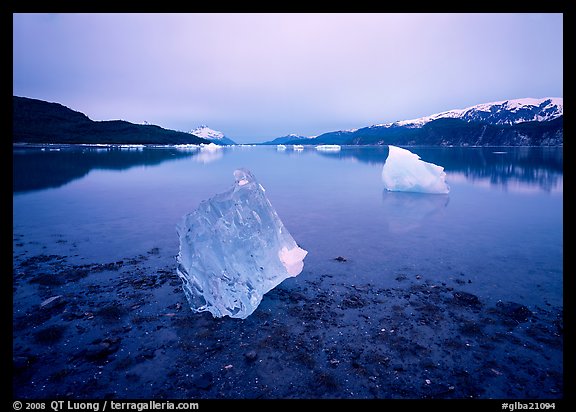


On the first day of our ten-day sea kayak trip, we had gotten up at 6am.
After a full day of paddling, we arrived at our
destination, a grassy flat near the mouth of McBride Inlet, at 2am.
By the time we had finished setting up camp, it was 3am. I retreated
to my tent, but didn't feel asleep. I felt excited by possibilities
and energized by the clear sky and the lingering half-light of the
Alaskan summer, that I could sense getting brighter. The world felt so
beautiful and just invited exploration. I wandered around the tidal
flats until I saw this translucent iceberg that was lying more than
a hundred feet away in water. I knew that the water was very shallow,
and that with the fast rate at which the tide was moving back, if I
waited, it would be totally out of the water. So I immediately wadded
into the water with the camera mounted on a tripod, the lupe and dark
cloth around the neck, and a film holder in my pocket. This image
reminds me of the curious state of heightened awareness I found myself
in after being awake for almost 24 hours.


What photography project is currently at the top of your list?

It's been winding down, but I am still working most actively on the National Parks project. 

What advice would you give aspiring photographers?

Shoot what you love, not what you think may sell. I think it is shortsighted to shoot only what you think will sell. First, because you don't know with any degree of certainty what sells and what doesn't. Second, and more important, because, as an artist, what you should be trying to create is raising your profile.  This is done by producing outstanding work, which is awfully difficult if you don't love what you are shooting. By the way, I am taking my own advice. Personally, I never expect all the images I publish on the website to sell. They are there because I find them interesting for some kind of reason.

What advice would you give photographers who want to have more effective web sites?

Have a clear goal and a path to realize it. I see a lot of photographers trying to achieve all sorts of things with their websites: stock licensing, print sales, getting assignments, you name it. Yet when you analyze the components of their sites, you see that none is particularly effective for any of those goals. For instance, since you are a stock shooter, you know that stock is a numbers game. Yet many do not even design in order to maximize traffic.

Facebook is capturing an increasingly greater percentage of web traffic. Are you utilizing Facebook (or any other social media), and/or do you have any opinions on the importance of incorporating a Facebook presence into a photographer's strategy for visibility?

I've been testing the waters but I remain skeptical of the value.  On FB I have only a personal page because I do not like the idea of an artist setting up his own fan page -  although from a SEO point of view it does make so sense. For status updates, I prefer twitter, there seems to be more information and ideas flowing around.

Do you utilize flickr or other photo sharing sites (and if so how)?

No. I would if I had the time.

Do you promote yourself outside of the Internet?

Just a few years ago, I suddenly realized that as a visual artist, you have to exhibit your prints, because, even in this day and age, the print remains an ultimate realization of your work. So although I have a short exhibit history, I've been trying to catch up. Other than that, I've never sent any promo piece or solicitation to anybody so far. Unlike some, I don't really like to promote myself or even to sell. With that respect, my Internet strategy was a good match.

What qualities in you are most responsible for your success as a photographer?

Same as the qualities that were responsible for my success as a scientist: curiosity, persistence, ability to grasp the "big picture" and at the same time take care of details and technicalities.

Where do you want to shoot that you have not yet been to?   

Everywhere (truly, even in the US Midwest!,) but especially in the Himalayas, South America, Africa, and Antarctica.

What is your biggest challenge as a photographer?

To create work which is fresh and meaningful. There is so much great work that has been created in the past and right now, it's difficult to find new ideas. When one tries to shoot with a new style or new techniques just to be different, it often ends up being gimmicky.

What is your biggest challenge as a photography business owner?­

To understand emerging trends in business and technology and take advantage of short windows of opportunity. If I hadn't understood the importance of search engines on the Internet a decade ago, I wouldn't be there today. However, nowadays, everybody is doing SEO. So what's next?

Are you optimistic or pessimistic about your future in photography?

I am optimistic about my future in photography. I feel I still have so much to learn, so much room to grow that the journey is going to be very rewarding. It could be that ten years from now, I will be at a very different place, and doing very different work than what I've been publishing so far.

What I am not necessarily optimistic about is the business of photography. Although the year is not finished yet, at this point it is a given that for the first time in 10 years I will experience a decline in revenue. There are some worrisome economic trends that you know well.  Historically photography has not always supported that many full-time practitioners, and we might return to that situation in the future. But that's OK.  Some of the most enduring and celebrated work in photography didn't sell well at the time it was created.

Monday, November 8, 2010

Having Fun and Making Money In Stock Photography

Funny picture of a tourist mounting an elephant during
"Mounting" an elephant during "Mahout" training can be...well...scary (but fun)!

Crop in on my face and you can see how much fun I really am having!

Elephants, Crocodiles and Creativity and Fun
I have just returned from a quick trip to Thailand where I photographed elephants, crocodiles, tigers and the flotsam and jetsam of travel. Getting out of my normal existence both provides me with fresh material to create my images and reminds me that there is so much more than sitting behind the computer creating stock photos. On this trip I got to hang out with elephants (during a "Mahout training experience"), play (that's right...I said play) with tigers, get a glimpse of everyday life in Thailand while visiting a Thai friend, got to taste coagulated pork blood (in an otherwise pretty good soup) and just plain had fun. Travel gets me recharged and stimulates new ideas and creativity, and a big part of that is having fun!

There Is Still Money To Be Made In Stock Photography
One of the first things I did when I got into my studio this morning was to check out my sales report at Blend Images. It was encouraging to see one image that I recently created, in its first quarter, made fourteen sales and brought in $343.73 cents to me. Sure, there was one sale for $1.40...a sign of the times, but there was one sale for $126.00 and several in the $50.00 range. It seems strange to be enthusiastic for such small sums (coming from an RM background) but they do add up. Keep in mind also, that this was the first quarter that this image was available and, if it follows the norm, sales will build over time. I have noticed that a satisfyingly high number of my recent images have been doing well. There are other images that sold more times, and a whole lot of images that sold fewer times, and made me less money, but this one caught my eye because I really didn't expect it to do quite this well. After twenty plus years in stock I still can't tell how well an image will do with any certainty, but at least I can say that despite all of the negative news out there, there is still money to be made in stock photography.

RM vs. RF: A Balancing Act
One thing that isn't fun for me is determining whether an image should be RM or RF. The image in question is an RF image. I create and contribute RF images because I actually do make money on them. I am convinced that for some images they will make much more as RF than RM.  On the other hand many designers and art directors I speak with claim they can't afford RM images. Of course, I think they are mistaken...but what they believe becomes their reality and I believe it would be a mistake to abandon such a huge section of the market for stock photos. I prefer to make images for the RM market, and I still make about half of my images for that RM market, but RF has become integral to my income. My Rights Managed income has  become much more volatile while the Royalty Free income is much more stable. I am always performing a balancing-act trying to decide which images to put where, which will do best in RM and which in RF. It makes me a little bit crazy, but then you have to be a bit daft to be in the business anyway!

Old Concepts, New Work and Inspiration
I have to admit that upon returning to my studio I also took a quick look at some of the new work on various agencies. It is a little frightening to see the never-ending torrent of un-original work that continues to pour into the marketplace. What a treat it is to come across the occasional image that has some emotional appeal, some clever new way of expressing a tried-and-true concept, and especially to come across an image that is so special it blows me away and encourages me to press all that much harder to come up with my own images that are truly worthwhile.  I have to admit that finding images that really inspire me doesn't usually come from searching stock agencies. Such special images are certainly in the agency collections, but can get buried pretty deeply in with all the lesser images.  In any case, it sure seems clear to me when I look through photography, whether it is in agency collections, magazines or just Googling the net, my future in stock is in making unique and interesting imagery. Actually, I believe that anyone who hopes to do well in stock photography needs to be making at least some images that inspire. For me, one of the best ways to creativity, and therefore inspirational images, is through having fun!


Tuesday, October 26, 2010

Elephants, Tigers and Shooting Stock In Thailand

My impromptu head massage by an elephant during a stock shoot was actually kind of creepy...and slimy!

Elephants, Tigers, Alligators and Shooting Stock
I am off to Thailand early tomorrow morning for twelve days of shooting stock. My partner Stephanie and I will be keeping our eyes open and cameras ready to capture whatever opportunities come up as well as undertaking a few planned shoots. We have arranged to photograph elephants, tigers and alligators (or are the crocs?). All in all it should be a fun and fruitful trip!

Elephant Massage
As you can see from the elephant photo above (that’s me getting the head massage), I have shot elephants before in Thailand. BTW, having an elephant’s trunk massage your baldhead is actually kind of creepy…and slimy! I had a great time shooting elephants before and have arranged to spend a day learning to be an elephant Mahout (trainer). I get to spend a whole day with my own elephant learning how to direct him or her, giving the elephant a bath, and then taking a jungle trek atop the great beast! All the while Stephanie and I will be keeping ready for photo opportunities for our stock collection and raw material archives.

Expectations and Attitude
I did photograph a tiger here in the U.S. once, but this should still be fun and a great opportunity for some awesome “parts” from which to create my composite, conceptual stock photos. Of course, part of what makes for a successful stock photo trip, for me, is not getting too attached to your “expectations”. There are quite a few things that can go wrong...and if they do go wrong, and you don’t get what you thought you would, why wreck your trip over it? If you don’t get the shots, you don’t get the shots…but you don’t have to suffer over it. Very Buddhist of me…and heck, sometimes I actually manage to achieve such a great attitude. I’d rather just get the shots though….

Great Selling Stock Photos and Grab Shots
I have had some great selling stock photos over the years that were grab shots on my travels, so I always try and stay as open as possible to those opportunities. Once, on a trip to Burma, I pressed my camera up to the glass in a waiting area in the Mandalay Airport (or was it the Rangoon Airport…uh…I don’t remember) and, with a touch of Photoshop, ended up with a great picture of a gangway on the deserted tarmac.
This gangway on a deserted tarmac in Burma represents both opportunities and missed opportunities as well as connections and networking.
This shot paid for the entire trip and then some with its royalties, those sales have dried up recently as there are now a spate of such images. Hey, I think that may be the first time I have ever used the word “spate” before! In another case I was in a train station in Mumbai, raised my camera high above my head, and fired off a few shots at a fifteen of a second (to blur the crowd) before a machine-gun toting guard suggested I desist…which I promptly did. However, one of those grab shots has, at this point, paid for half of that trip! Cool!
People in motion at a train station in Mumbai, India.


Internet Access, Time and Sharing on a Photo Blog
At any rate, I will try to use this photo blog to share some of my trip…but how much depends on Internet access (which should be good), and how much time I have (who knows) and, well, again, who knows! Worst-case scenario, there will be a lot more material to share when I return. Stay tuned!

Sunday, October 24, 2010

Looking Into the Future of Motion (Video) Stock


Creating clips that can stand alone, as in this slow motion wine pour clip, may be important for motion stock success in the coming years.

Motion Stock
Recently I participated in an exchange, in a stock photo forum, on the topic of motion stock. It was only a brief exchange but there were some great thoughts that have helped me gain a bit more clarity on the possibilities, and limitations, of motion stock and how stock footage may fit into my photography future.

The Importance of Editing Motion 
One stock photographer, who has been adding a lot of video into his stock shoots, shared how important it has been for him to edit together a short film from each of his stock shoots. He went on to explain that the exercise was invaluable for helping him to understand the kind of clips that needed to be captured during a shoot and the importance of providing for transitions. Editing his shoots into short films is making him a far better motion stock shooter. Further, those short films will then be available, as well as the individual clips, for stock licensing.

Finding Appropriate Clips Is Challenging
Another photographer, who also is very experienced in the motion world, went on to say that finding clips that can be edited into an a motion project in progress is very challenging, and that in his experience, in most cases, it was actually easier and more efficient for him to just shoot what was needed himself. There are issues of format, of frame rates, of lighting quality and quantity, of the "feel" of the footage...challenges of continuity that we don't face as still photographers.

Individuals Licensing Motion Stock Successfully May Become Rare 
Hearing about the challenges of working stock footage into motion projects (reading it actually), it dawned on me that as it is getting easier and less expensive to capture video almost by the day, it is getting easier and less expensive for those creating videos to shoot their own footage rather than to look for stock to fill their needs. Add that to the absolutely insane explosion in people shooting and providing motion stock and you can see that despite the exploding demand for motion, an individual photographer making good money from licensing stock motion might become even more rare!

A Demand For Stand Alone Clips
Yet another shooter, who has participated in both stills and motion for years even to the point of directing numerous television commercials, suggested that there will be an increasing demand for very brief stand alone videos that illustrate a concept or can be used as a generic ad for a product or service, perhaps as in a promotion for a travel destination.  I like hearing that since that is exactly the type of little clip I put together by combining a still image with some of my slow motion footage to create a video clip of a tungsten  light bulb exploding into an energy efficient CFL bulb.

Incredible Images, After Effects and Motion Efforts
A concept stock photographer that is currently doing some of the most incredible images I have seen is now using After Effects to create stand alone conceptual clips the echo his still style. These are beautiful and powerful clips and it is hard to not get excited about the possibilities for such motion efforts when watching them. That gives me further impetus to examine such a route for my own future.

Passion and Excitement are Paramount 
I actually did enjoy putting that light bulb clip together, and if I can just figure out a few more things to do that fit in with my own vision and approach, and that I can do with a very minimal monetary outlay, then I can see at least an increased effort on my part on getting into motion.  As with stills, I still see a vital component of success being having passion and excitement for whatever sort of visual you are creating.  The competition is just going to be far too intense for anyone who is simply creating imagery to make money.unless, I suppose, you have an intense passion to create images to make money!

Friday, October 22, 2010

Image Theft, Copyright Registration and Growing Your Income


Whether you are communicating about Spam, Fraud, image theft and infringement or some other sort of unwanted Internet contact, this stock photo of numerous hands reaching out of a businessman's computer monitor, can help add impact and attention to your message.
Online theft is rampant...what are you doing to combat it?

Image Theft As An Income Source
I came across an interesting post today by photographer Thomas Hawke in which he views image theft as a potential source of revenue. That ties in with a “success story” circulated in the PicScout newsletter in which one of their clients, a niche stock photo agency, is deriving 50% of their income from tracking down infringers. They take the high road by viewing infringers as a possible long-term clients and attempting to convert infringers into licensors…an interesting approach!

Something You Can Do To Help Stop Infringement
As we all know, image theft has become huge and hurts all of us attempting to support ourselves with our photography. It is disheartening, at least for me, to see all of the appropriated images of mine circulating on the Internet, attributed to others, sometimes offered for sale by others and so on. I hate having to put watermarks on them as well. It is in the interest of all of us, professionals and non-professionals alike, to see progress made in stopping, or at least slowing down, infringement. One simple thing you can do, right now, is to take a minute of your time and send a letter to your congressional representatives to support S. 3804, the “Combating Online Infringement and Counterfeits Act,”. The whole process took me less than two minutes. 

Register Your Images!
After years of neglecting to register my copyrights I am now a convert. It really is pretty easy to register your images online. I think it is important that all of us put out that little bit of extra effort to watermark our images, register the copyrights, be proactive in promoting efforts to control infringement, and to help educate people about copyright matters. In the years to come this is come to become more and more important if we are to continue to reap the rewards of our own creative efforts.


Like